
Blog · Sleep · 7 min
Vamping: why your teenager isn't sleeping because of the phone (and how to switch it off for real)
Vamping is using the phone at night in secret, in bed, in the dark, long after the house has gone quiet. It happens to nearly every teenager for two reasons: the apps are built so you don't put the screen down, and by that hour there's no willpower left to close them. It isn't laziness. It's design.
If you're here, it's because you see it every morning: they get up wrecked, in a foul mood, and you know, or strongly suspect, that they were on the phone long after the light went off. You're not exaggerating and you're not being a nag. Here's what usually gets left out: the science of why it happens, the practical part nobody pins down (what time, where it charges, what about the alarm clock, what about weekends) and how to make night be night without a fight every day.
Vamping: why the phone at night stops your teenager sleeping
Short answer: screen light holds back melatonin, the hormone that tells the body it's time to sleep, and the apps keep the brain switched on at exactly the point it should be powering down.
Start with the light. Screens put out a lot of blue light, the wavelength around 460 to 495 nanometres, and it's the one that fools the body clock hardest. In a Harvard Medical School experiment, blue light suppressed melatonin for about three hours, against roughly an hour and a half for green light of similar brightness, and shifted the circadian rhythm twice as far (Harvard Health Publishing, "Blue light has a dark side"). Translated: looking at a phone in bed tells your child's brain that it's still daytime.
But the light is only half of it. The other half is what's inside the screen. One more episode, one more video, a scroll with no bottom to it. The apps aren't made to be closed, they're made to hold you. And the numbers show it. In a Common Sense Media study that tracked the phones of 203 young people for a week, 59% of them used their phone at some point between midnight and 5am. That's your child and most of their year group.
And here's the finding that surprises parents most: they don't even have to use it. A 2016 meta-analysis in JAMA Pediatrics pooled 20 studies and 125,198 children and adolescents, and found that using a device at bedtime roughly doubled the odds of not getting enough sleep. Sleep was worse even for children who simply had a device within reach at bedtime without using it (Carter et al., JAMA Pediatrics, 2016). A phone on the bedside table, on silent, is already taking sleep. The head knows it's there.
Which is why the American Academy of Pediatrics is blunt about it: screens off an hour before bed, devices out of the bedroom overnight. And the American Academy of Sleep Medicine puts teenagers between 13 and 18 at eight to ten hours a night. Compare that with what yours actually gets on a school night and you have the size of the problem.
Why "phone off at eleven" doesn't hold, however sincerely they promise
Short answer: because you're asking a tired teenager to use willpower against the best-designed hooking device in the world, and at that hour the fight is already lost.
Be honest about it. They take the phone to bed with every good intention. "I'll answer one friend and then I'll stop." But at eleven at night, in the dark, with nobody watching, willpower is at rock bottom. It's the worst moment of the day to ask anyone to self-regulate. And it isn't a flaw in them: adults, with a fully built prefrontal cortex, don't put the phone down first time either. You're asking a fifteen-year-old brain, still under construction, to do something you don't do well yourself.
That's why the standard advice falls short. "Agree a time." "Talk to them." "Get them a proper alarm clock." All of it helps, and all of it shares the same blind spot: it depends on your child deciding, at the crunch moment, to close the app. And that decision is exactly the one vamping skips every night.
The agreement isn't what's failing you. What's failing is that it rests on willpower, and at two in the morning there isn't any.
This is where most articles stop. They explain blue light, hand you four generic tips and move on. The hard part, how the rule gets kept once you're asleep, nobody touches. So let's go there.
What time, where does it charge, and what about the alarm?
This is the part nobody pins down, and it's the part you actually need: numbers and practicalities.
What time does the phone go? Aim for one screen-free hour before sleep, as the AAP advises. If they go to bed at 11pm, the screen goes off at 10pm. Pick a fixed time and keep it the same: the body learns by routine, and a time that moves every day never becomes a habit.
Where does the phone charge? Outside the bedroom. It's the simplest measure and the one that does the most work, because it goes straight at the JAMA finding: if the phone isn't in the room, it can't ask for attention all night. One shared charging spot in the living room or the kitchen, where the whole family's phones sleep (yours included, since that's what makes it credible), turns "put your phone away" into how the house works rather than a punishment aimed at one person.
And the alarm? The classic move: "but I need it as my alarm." The answer is an alarm clock, the old kind, for about a tenner. You give the function back to a device that does only that and you remove the excuse for a phone in the bed. If they also use the phone for music, a small speaker does the same job without opening a door back to TikTok.
And weekends? Be realistic: the time slips at the weekend. Moving it later is fine, midnight instead of ten, as long as there's still a time and it still charges outside the room. What wrecks sleep isn't one late Saturday, it's arriving at Sunday night with the body clock so far out that Monday is a write-off. Hold the floor, flex the ceiling.
The catch is that all of this, again, depends on being kept. You can buy the alarm clock, set up the charging spot and agree the time, and the phone can still end up in the bed "just for a minute". One piece is missing: switching it off for real, without anyone's willpower being involved at that hour.
The night barrier that doesn't get bypassed: physical, not a promise
The "no" belongs to the rule, not to the parent.
This is where Monk comes in, and it's worth saying plainly. Monk doesn't switch the whole phone off. It doesn't block calls and it doesn't block the alarm. It blocks the apps that hook, which are the ones causing the vamping.
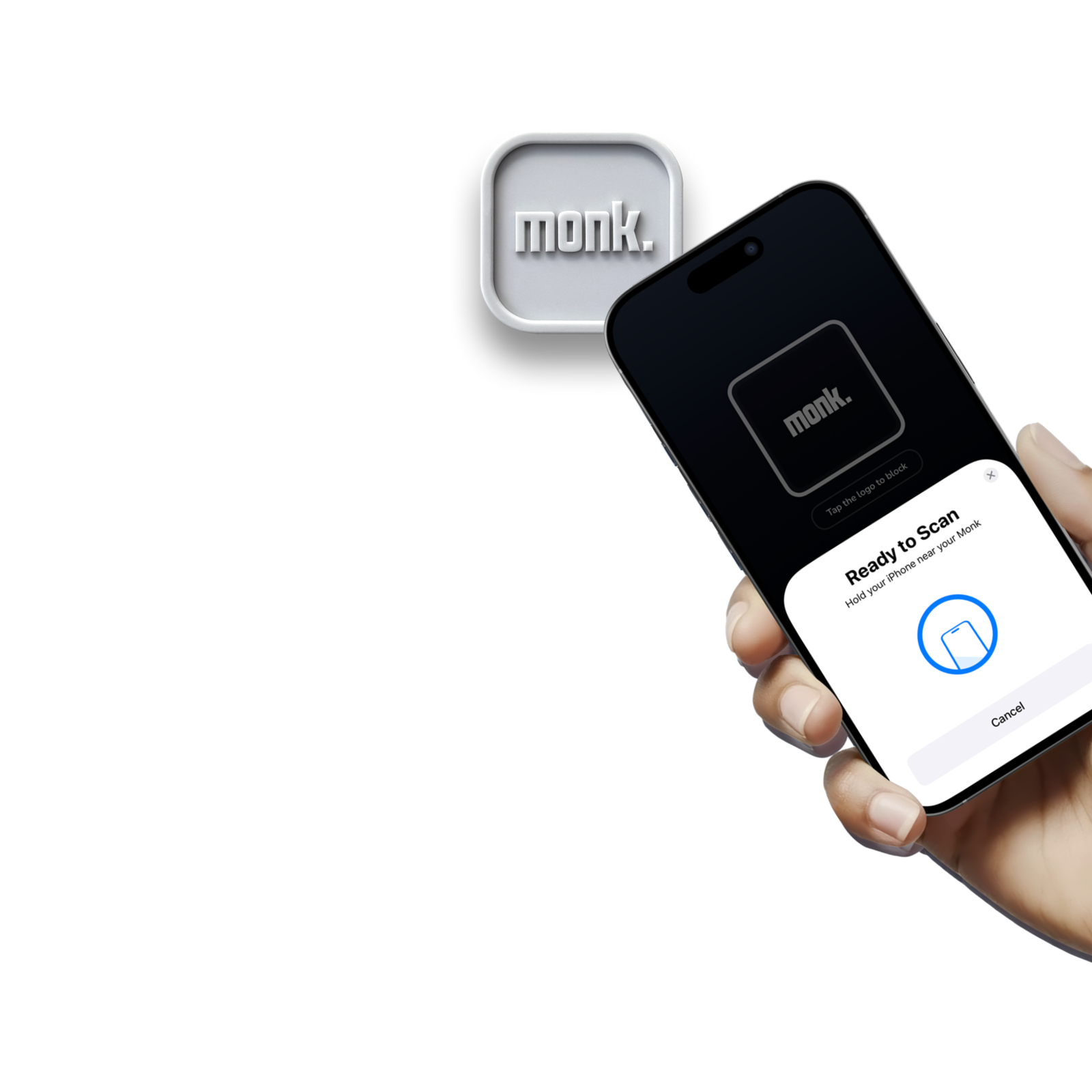
The Monk is a physical device, the size of an AirTag, magnetic, no battery, that blocks apps on an iPhone. At night it works like this: your child monks themselves before bed. You set up a session, say 10pm, and at that hour TikTok, Instagram, YouTube and whatever else you agreed on close by themselves. And here's the difference from any parental control: to open them again, someone has to scan the Monk. Always. No soft unlock, no code to guess, and restarting the phone or changing the clock does nothing. The app carries three emergency unlocks for genuine emergencies, and they're finite. If the Monk is in the living room, the decision has already been made.
Look at what that solves. Your child can still keep the phone on the bedside table for the alarm or for music: they still have a phone, calls come through, the alarm goes off in the morning. What they don't have, between 10pm and 7am, are the apps that keep them awake. The AAP says the phone shouldn't sleep in the bedroom; Monk means that if it does, it matters a lot less, because the part that hooks is genuinely off. And the rule doesn't rest on a tired teenager's willpower at two in the morning. It rests on an object sleeping in another room.
The best part: the conflict stops being yours. You're not the one saying "phone off" for the tenth time, and there's no negotiation at 11:40 every night. An object holds the rule, not an argument. And one detail changes everything: if you monk yourself at night too, it stops being a punishment and becomes the way the house runs. Kids don't do what they're told. They do what they see.
Nobody's selling you magic. On iPhone, no solution is a 100% wall, because Safari exists. What Monk kills is the automatic gesture, the "I open the app without thinking" that sits at the heart of vamping. Every app is built by whole teams to hold attention. You don't beat that with good intentions at eleven at night. You beat it by changing what's in the room.
What Monk is, and how you use it at night
Monk is a small Spanish company built around giving time back. The product is the Monk: a physical NFC device with no battery that blocks the apps you choose on an iPhone (iOS 16.2 or later). It isn't another parental control app, on purpose. The solution can't live inside the problem.
Sorting out the nights takes three steps:
- You choose which apps close at night and schedule the evening session on your child's iPhone, say everything shuts at 10pm. The alarm and calls keep working.
- The Monk sleeps in the living room, at the charging spot where everyone's phones sleep.
- They monk themselves at bedtime. Reopening an app would mean getting up and scanning the Monk, which is in another room. The rule is held by an object, not by an argument at 11:40 every night.
No confiscating the phone every night, no fight, no depending on a tired teenager making the right call at the worst hour of the day. A physical barrier that turns "no social media at night" into a house rule that keeps itself.
If the phone at night is your battle too, the adults' version of this, it helps to read how to stop using your phone at night without relying on willpower alone. And if you want the full picture by age, here's how much screen time by age, with the official guidance behind it.
Frequently asked questions
What time should a teenager give up their phone at night?
The American Academy of Pediatrics recommends screens off an hour before sleep. If they go to bed at 11pm, the phone goes at 10pm. More important than the exact hour is that it's always the same one, so the body builds a routine, and that the phone charges outside the bedroom. With a scheduled evening session, that time stops depending on them respecting it.
Does night mode or the blue light filter help?
A little, but it doesn't solve the problem. The filter cuts some blue light, which is fine, but it doesn't touch the other half of vamping: the apps are still there, still holding on, still keeping the brain switched on. Warming the screen to orange doesn't stop anyone scrolling until two. For that you need the apps to go off, not just change colour.
Can I block the apps only at night and still leave them an alarm?
Yes, and that's exactly what the Monk does. You schedule a session, say 10pm, that closes the apps that hook, while the alarm, calls and texts carry on working normally. Monk doesn't switch the whole phone off, it blocks what you decide on. To open them again, in the morning or whenever, someone has to scan the Monk, which sleeps outside the bedroom.
What if my teenager uses the phone once they think I'm asleep?
That's the usual case, and it's exactly what vamping is. In one tracking study, 59% of the young people used their phone between midnight and 5am. Which is why agreeing a time isn't enough: at two in the morning nobody is supervising. With a physical barrier that shuts the apps at a fixed hour and only unlocks by scanning the Monk, it stops mattering whether you're asleep. The rule can't be beaten by waiting you out, because you're not the one holding it.
Let night be night
Your child doesn't sleep badly because they don't care. They sleep badly because you're asking them to switch off, by willpower, the best-designed device in the world for not being switched off, at exactly the hour they have the fewest defences. You don't win that with a talk or with "eleven o'clock, phone off". You win it by taking the decision out of the equation.
Let night be night. No fights, no supervising, no relying on a teenager's willpower at two in the morning.
Let night be nightNo monitoring · No codes to guess · Calls and the alarm always work · Ships within Spain today, list open for the EU and UK


